
- Home
- Painting Services
- Exterior Painting
Exterior Painting Booked Inside the Curing Window
Exterior painting booked into the months a coating can actually cure, with washing, scraping, spot priming and caulking done first, and rot called out before anything gets covered.
An exterior coating needs a surface warm enough to form a film, and in this valley that means roughly fifty degrees and holding, read on the wall rather than off a weather app. It also needs a dew point that is not sitting right under the surface temperature, because siding that sweats overnight traps moisture under a coat that went on at four in the afternoon. That is what decides the method, not whether we take the job. A standard coat applied too cold looks fine in November, then never cross links, never gets its adhesion, and lets go in sheets along the south wall by the first warm week of spring. So in the cold we switch products to a film formulated to cure down near thirty five degrees, work the sun side of the building through the warmest hours of the day, and tent and heat the wall where the surface will not come up on its own. That costs more than the same house in June. You get both numbers written down and you choose which one you are buying.
The walls do not weather evenly either. South and west take the sun and the driven rain, so the coating there usually runs two or three years ahead of the north side, and pricing a house as one round number without reading each elevation misses that entirely. Clapboard opens at the butt joints. Cedar shingle goes chalky and thins out along the exposed edge. A porch ceiling peels from the top down when an ice dam has been pushing water back under the roof edge, and that is a roof problem wearing paint problem clothes. We walk all four sides, look at the trim caulk, the window aprons, the gutter line and the sills, and tell you which parts are paint and which parts are carpentry before a number goes on paper.
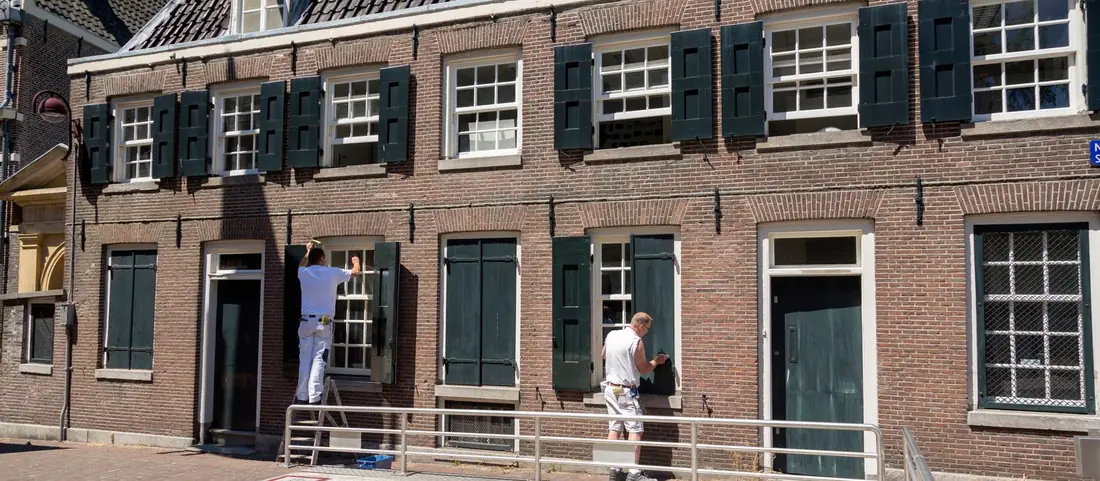
What the visit covers
- Wash the siding and let it dry through before prep starts
- Scrape and sand every failing edge back to sound paint
- Sound the trim, sills and porch posts and call out the rot
- Prime bare wood the same day the surface gets opened
- Cut out failed caulk and reseal trim, corners and joints
- Reseat loose glazing putty at old sash and storm windows
- Mask roofs, decks, walkways and anything planted at the wall
- Coat one elevation at a time, working behind the shade
- Brush clapboard butts, shingle edges and window trim by hand
- Flag the gutter or downspout line that is soaking the wall
What we will not paint over
Paint over rot is money burned, and it is the most common thing we find on a house that got a cheap coating last time. A soft bottom rail on a window, a punky column base where the porch floor holds water, a sill that gives under a screwdriver, a corner board gone spongy behind an old bead of sealant. Coating hides all of that for a year, then the coating fails and the wood underneath is worse than it was. We sound the trim with a tool instead of judging it by eye, and anything soft gets flagged with a price to cut it out and replace it before prep carries on. If you would rather bring in your own carpenter, that is fine, we hold the schedule and work around them.
The order never changes. Wash first, so nothing gets sealed under the film, then give the wood a day or two to dry depending on what the weather is doing. Scrape and sand back to a sound edge and feather the transitions, so a repaint does not read as a map of every old failure. Get primer on bare wood the same day it is exposed, because raw wood left open over a weekend takes on moisture and whatever follows never bonds properly. Caulk after primer rather than before it, so the sealant grips a sealed surface. Then coats go on, elevation by elevation, following the shade around the house so nothing flashes in direct sun. Surfaces and number of coats sit on the written scope before a ladder goes up.
About exterior painting
If your question is not here, call and ask. We would rather tell you a smaller job is enough than sell you a bigger one.
When is it too late in the year to paint outside?
Once the surface stops holding near fifty degrees through the drying hours, a standard exterior coating stops being the right product, and around here that usually lands somewhere in late October. Night temperatures matter as much as the afternoon, because a film that goes on warm and then chills before it sets never reaches full adhesion. From that point we switch to coatings formulated to cure down near thirty five degrees, work the sun side of the building through the warmest hours, and tent and heat the surface where the job calls for it. It costs more than the same wall in July, and we show you both numbers.
How long should an exterior paint job last here?
It depends on the wall. Sheltered north and east elevations can hold a coating for the better part of a decade. South and west take sun and driven rain and give out years earlier, which is why some houses only need two sides recoated at a time. Prep decides most of it anyway. A film rolled over a dirty, glossy or unprimed surface can start releasing in one winter, whatever it cost per gallon.
Can you paint just the trim, or does it have to be the whole house?
Trim on its own is a normal job and on plenty of houses it is the right call. Trim, sash, doors and porch parts take the weather harder than the field of the siding, so they fail first. We scope it as its own line with the caulk work and the priming included, and the same goes for a single elevation. What we will not do is quote a whole house from the sidewalk, because the price lives in the prep.
One price for exterior painting, agreed before anyone starts.
Half an hour at the property, at no charge, and you walk away holding the room by room list and one number.