
- Home
- Flooring Services
- Commercial Floor Care
Floor Care That Runs After Your Building Closes
Strip and wax, scrub and recoat, burnishing and concrete work for VCT and hard floors, scheduled overnight or over a weekend so nobody in your building loses a day.
A VCT floor that only ever gets wet mopped turns gray, and the finish is not what went wrong. Mopping moves soil around in the water and leaves a thin film of it behind, and the film builds a haze that light no longer reflects through. Add the fine grit that comes off the sidewalk and gets ground into the finish by foot traffic and you get a surface that is scratched, dull and dirty at the same time, which is why mopping harder does nothing. The finish underneath is usually still there. It just cannot be seen. So the first thing we do is establish what you actually have: how many coats are on the tile, how deep the scratching runs, whether the finish has yellowed or worn through to bare tile in the lanes, and how the traffic actually moves through the space.
That read decides which of two jobs you are buying. A full strip takes every coat off with a stripping solution and a machine, gets neutralized and rinsed so nothing is left to fight the new finish, and then gets built back up, usually four or five coats on open tile with drying time between each one. It is the expensive one and it is the one you do least often. A scrub and recoat is the other, and most buildings need it more than they know. If the top coats are scuffed but the base coats are sound, we scrub off the damaged surface, leave the good film in place, and put two fresh coats over it. Half the labor, a fraction of the chemical, and no room sitting empty for an entire night.
What the visit covers
- Read the existing finish before quoting a strip or a recoat
- Strip every coat off, then neutralize and rinse the tile
- Lay four or five coats on bare tile, dry time between each
- Scrub and recoat when the base coats are still holding
- Burnish the lanes on a set cycle to bring the gloss back
- Set a written schedule per area instead of one blanket date
- Deep scrub grout and hard tile in restrooms and kitchens
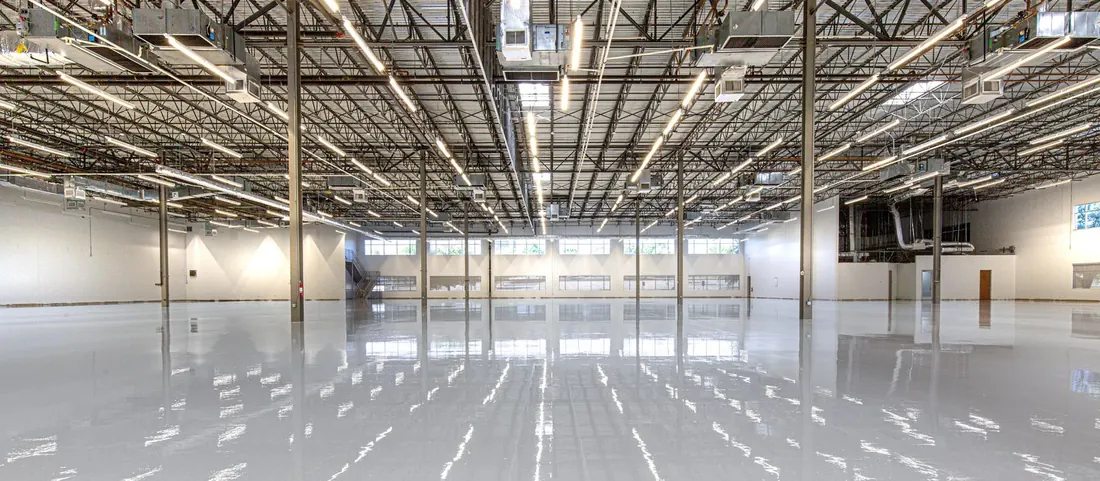
- Clean, seal or coat concrete in warehouse and shop space
- Size the entrance matting to the door and the traffic
- Run the work overnight, early or on a weekend
Matting, salt and the winter floor
Winter is what kills a commercial floor here, and it comes in through the front door. De icer melts into a white crust on the finish, and a chloride residue left to sit will haze the film and then start dulling it for real. The grit that comes with it does mechanical damage, cutting the finish on every pass. You cannot mop your way out of that. You can stop most of it at the entry. The rule of thumb is fifteen feet of matting inside the door, in three stages: a scraper section outside, a coarse section at the threshold, then an absorbent run inside long enough that somebody takes several steps on it. Most buildings have three feet and wonder why the lobby looks tired by January. Matting is cheaper than refinishing and it is the one change that shows up on the whole floor.
Nothing here happens during your business hours. A strip and refinish needs the space clear, the furniture out and the floor untouched while coats dry, so it runs after close, overnight, or across a Saturday and Sunday when a suite can sit empty for two days. Burnishing runs on a cycle you set: weekly in a lobby, monthly in a back corridor, and we put that cycle in writing per area so nobody argues about what was supposed to happen. Warehouse and shop floors are a different surface with the same logic. Bare concrete dusts, stains and absorbs whatever gets spilled on it, so it gets cleaned, then sealed or coated depending on what rolls over it and what lands on it. We are licensed and insured. The certificate lands on your desk with the proposal, not after somebody asks for it.
About commercial floor care
If your question is not here, call and ask. We would rather tell you a smaller job is enough than sell you a bigger one.
How often does a VCT floor need a full strip?
Less often than most vendors sell it. If the floor is burnished on a real cycle and scrubbed and recoated when the top coats wear, you can go years between full strips. Stripping is hard on tile, it puts chemical down the drain, and it costs you a night. We would rather set a maintenance cycle that keeps the finish alive and strip only when the film has yellowed, worn through in the lanes, or built up so thick it is going amber at the edges.
Can you work without closing the building?
That is the normal arrangement. Most of this runs after close or overnight, and a full strip and refinish usually takes a weekend so the coats get their dry time. In a building that never really empties, we break the floor into zones and do a section at a time behind barriers, so half a corridor stays open while the other half cures. You get the area schedule in writing, with the dates, so your tenants and your staff know what is closed and when.
What about the concrete in our warehouse?
Bare concrete is porous, so it dusts under traffic and it holds every oil spill. The options run from a clean and a penetrating sealer, which is cheap and keeps the dust down, to a coating that gives you a washable surface and real chemical resistance. Which one depends on what runs across it, whether forklifts are turning on it, and how much downtime you can give the floor to cure. Slab moisture has to be tested first, because a coating over a wet slab peels.
One price for commercial floor care, agreed before anyone starts.
Half an hour at the property, at no charge, and you walk away holding the room by room list and one number.