
- Home
- Cleaning Services
- Upholstery & Sofa Cleaning
Upholstery Cleaning Starts With the Tag on the Frame
Sofas, sectionals, chairs and mattresses cleaned by whatever the fabric code on the tag allows, with a test in a hidden spot first and low moisture methods so no cushion is left soaked through.
Somewhere on your sofa there is a tag with one letter on it, and that letter decides everything that happens afterward. W means the fabric takes a water based cleaner. S means solvent only, no water at all. WS will accept either. X means vacuum and nothing else, because any liquid marks it. The tag usually sits on the deck under a seat cushion or stapled to the webbing beneath the frame, and on a sectional each unit can carry its own. Finding it costs a minute. Skipping it is how a good piece of furniture gets ruined in one afternoon, since water on an S coded fabric dries as a hard edged ring, and some of those weaves shrink and pucker along the seam once they have been wet. When the tag is gone or the printing has rubbed off, we stop guessing and start testing.
Testing means somewhere nobody looks. Behind a skirt, the back face of an arm that lives against the wall, the underside of the deck. A little solution goes on, then a white towel presses into it and comes up for inspection. Color on the towel means the dye is not fast and a wet method is off the table for that piece. We also watch how the fabric behaves while it dries, because certain weaves come back stiff or show a water line long after the towel looked clean. Then the work stays as dry as the material will let it be. A hand tool with a controlled spray, recovery on the same stroke, a pass with a dry towel. Foam inside a cushion holds water long after the face feels dry, and a cushion still damp on the inside is how a couch starts smelling like a cellar.
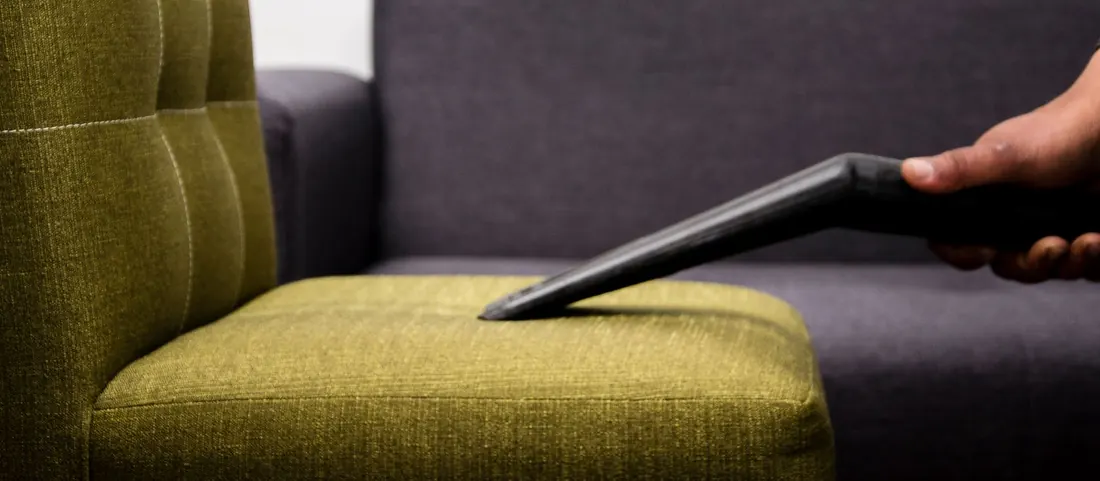
What the visit covers
- Find and read the fabric code before anything gets opened
- Test a hidden area for dye bleed and for water marking
- Dry vacuum the deck, the seams and under every cushion
- Use a hand tool with controlled spray and instant recovery
- Work microfiber evenly so it does not dry with a ring
- Brush the nap back one direction while it is still damp
- Clean both faces of loose cushions, not only the top
- Chase odor to where it started instead of spraying over it
- Clean and condition leather by a method meant for leather
- Do the mattresses on the same visit while the gear is here
Leather, sectionals, covers and mattresses
Leather is not fabric cleaning with a different bottle in your hand. Finished leather carries a pigmented topcoat that takes all the wear, so the job is lifting body oil and soil off that coat without stripping it, then putting conditioner back into the hide. Unfinished and semi aniline hides drink whatever lands on them, a water spot sets in seconds, and those get far more care and far less liquid. What no cleaning does is repair. Color worn off the crown of an arm, a crease gone dry and split, dye rubbed away at a headrest: the topcoat there is gone, and conditioner slows what comes next without putting a finish back. The zipper on a cushion cover is the other trap. It exists so the foam can be assembled, not so the cover can go through a wash cycle, and covers that do shrink enough that the corners never sit square again.
A sectional gets treated as one piece, because the soil is always worst where two units meet and nobody ever vacuums. Same with the deck under the cushions, which collects body oil, crumbs and whatever the dog brought home. That is also where odor lives. Spraying the top of a cushion masks a smell for about a week, so we work the source instead: the deck, the seam, the frame rail below, whatever soaked past the fabric. Mattresses ride on the same visit and the same tools, dry vacuumed first, then a light pass over the face and the sides. Two things are not coming back. Dye that has already bled out of a throw or a pair of jeans is in the fiber for good, and an arm that has sat in a south window for years is faded, not dirty. You hear both before we quote.
About upholstery and sofa cleaning
If your question is not here, call and ask. We would rather tell you a smaller job is enough than sell you a bigger one.
What do the letters on the tag mean?
W is a water based cleaner. S is solvent only. WS will take either method. X means vacuum, nothing wet and nothing foamy. The tag sits on the deck under a cushion or on the webbing below the frame, and the letter describes the outer fabric, not the filling. If yours is missing or unreadable, we test a hidden area and work from what the fabric tells us rather than from a guess that costs you a sofa.
Can I just wash the cushion covers myself?
We would rather you did not, even though they zip off. That zipper is for assembly, not laundry. Most covers shrink in a wash cycle, and once they have, the corners will not seat and the seams sit crooked for as long as you own the piece. Some fabrics also lose their backing or their sheen in the drum. Leave them on the foam and let them be cleaned and dried in place, which is safer and usually quicker.
Can you get the pet smell out of a couch?
Usually, as long as we can reach where it started. Odor sitting on the surface leaves with the cleaning. Odor that went through the fabric into the foam or down into the frame needs treatment placed at that depth, not a fragrance laid over the top of it. We check the deck, the seams and the underside before quoting so you know what is being dealt with. If it soaked into a foam core nothing can reach, we say so instead of taking the job twice.
One price for upholstery and sofa cleaning, agreed before anyone starts.
Half an hour at the property, at no charge, and you walk away holding the room by room list and one number.