
- Home
- Flooring Services
- Tile Flooring Installation
Tile Fails in the Layers You Never See
Tile set over a floor stiff enough to carry it, on backer board or an uncoupling membrane, because the layers nobody ever sees are what decide whether the grout cracks.
Tile does not bend. Grout bends even less. So the first question on a tile floor is not which tile, it is how much the floor moves when somebody walks across it. Joist span, joist depth, spacing and what the subfloor is made of all feed into that, and plenty of houses around here were framed for a carpet and a pad, not for a stone floor and a mortar bed. You can feel it before you measure it. Stand in the middle of the room and rock on your heels. If the china rattles in the next room, that floor is going to crack tile at a joist line and there is no adhesive on the market that fixes it. The repair is structural: sister the joists, add a layer of plywood, or in some rooms pick a different floor. Better to hear that at the walkthrough than to chase a cracked joint line a year later.
Once the floor is stiff enough, the next layer is what separates the tile from the wood underneath. Plywood swells and shrinks with the humidity and tile does not, so bonding one straight to the other is asking for a failure. Cement backer board screwed down in a bed of thinset gives you a stable, mineral surface for the tile to grab. An uncoupling membrane does the same job differently, letting small movement happen below the tile instead of through it, and it eats less height where height is scarce. In a bathroom or a mudroom the waterproofing question comes next, and it is a separate layer from the tile. Grout is not a seal. Tile is not a seal. A shower pan, a curb or a floor under a laundry needs a real membrane tied into the drain, done before a single tile goes down.
What the visit covers
- Check the floor for deflection before anything gets ordered
- Add plywood or sister joists where the framing is too light
- Set cement backer board in thinset and screw it to pattern
- Lay an uncoupling membrane where height or movement demands it
- Waterproof wet areas as a layer, not with grout alone
- Dry lay the layout so the cut row lands out of sight
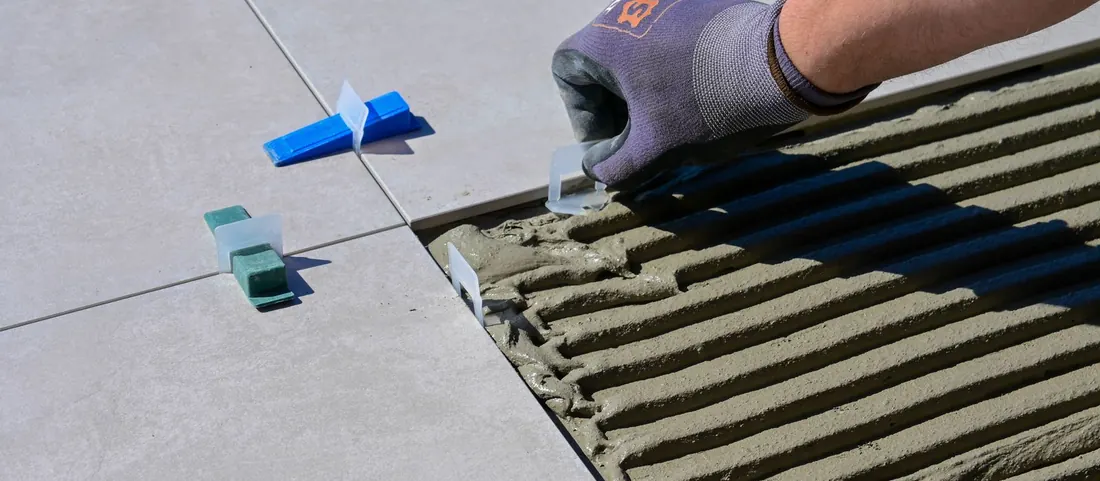
- Comb thinset in one direction and back butter large format
- Pull a tile early to confirm full coverage on the back
- Set electric heat mat in the mortar bed where you want it
- Grout, clean the haze, then seal the joints that need it
Layout, grout and a warm floor
Layout is decided before the first tile, not discovered halfway across the room. We snap lines off the longest sight line rather than off a wall that is out of square, dry lay a run, and put the narrow cut row where nobody stands: under the vanity, along the tub, behind the door swing. Nothing announces an amateur job faster than a two inch sliver of tile greeting you in a doorway. Coverage matters just as much and nobody checks it after the fact. Thinset gets combed in one direction so the air can escape as the tile is set, large format tile gets back buttered as well, and we pull a tile now and then to look at the back. Hollow spots under a corner are where a floor tile cracks first, usually the winter after somebody drops something on it.
Grout is a choice, not a default. Sanded grout for wider joints, unsanded for tight ones, and a high performance grout where the floor sees water or road salt, because a cement grout in an entry will absorb the gray slush that comes off boots from November on and never fully give it back. Cement grout wants sealing once it has cured, and sealing again later. Heated mats are worth mentioning here because tile is cold and an old house here is colder. An electric mat goes into the mortar bed under the tile, it runs off its own thermostat, and it turns a bathroom floor from the worst surface in the house on a January morning into the best one. It has to be planned early: the mat, the sensor wire and the height it adds all belong in the scope before anybody orders tile.
About tile flooring installation
If your question is not here, call and ask. We would rather tell you a smaller job is enough than sell you a bigger one.
My tile floor cracked along a line. Why?
A crack that runs straight for several tiles is almost always the floor underneath, not the tile. It usually follows a joist, a seam in the subfloor, or the edge of an old patch. Grout cracking in the same line says the same thing. Regrouting it buys a few months. The real fix is stiffening the floor and putting a separation layer between the wood and the tile, which means the tile comes up. We say that plainly rather than sell you a patch.
Do I need to seal the grout?
Cement based grout, yes, after it cures, and then again every year or two in a room that gets traffic and water. Sealer does not make grout waterproof. It slows absorption so a spill can be wiped up before it stains. In an entry that takes winter salt, sealing is what keeps the joints from going a permanent gray. Epoxy and the newer high performance grouts skip the sealing entirely, cost more, and are harder to work, which is a fair trade in the right room.
Can you tile over the existing floor?
Over a sound, well bonded tile floor on a stiff deck, sometimes, and it saves a messy demolition. Over vinyl, over a cushioned floor, or over tile that is already loose or drummy, no. We tap the existing field and listen before answering, because a hollow sound means the old tile is not holding and anything set on top of it inherits the problem. Height is the other check. Two layers of tile can leave a threshold and a door that no longer work.
One price for tile flooring installation, agreed before anyone starts.
Half an hour at the property, at no charge, and you walk away holding the room by room list and one number.